
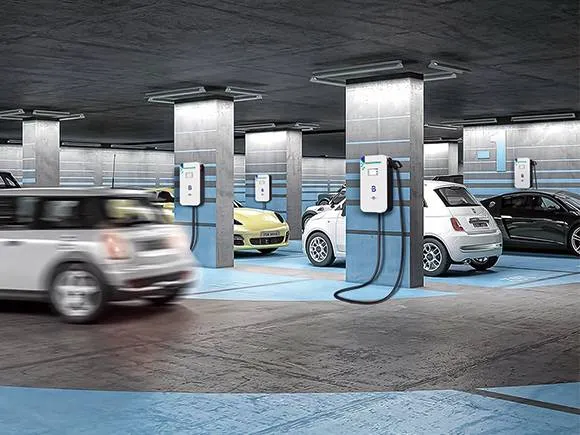
The Gap in the Lot: Why Offices Still Struggle
Let’s be blunt: most office car parks were never built for rolling batteries and peak-hour queues. Your EV charger solution has to handle more than cables and stickers; it must juggle time, energy, and people. Picture Monday at 9:10. Ten cars arrive, five chargers free, and the breaker is already close to peak demand. Surveys show that more than one-third of EV drivers rely on work to top up, yet many sites still push first-come, first-served. That burns goodwill and kWh. It also spikes costs when tariffs jump at noon (been there, right?). So, how do we scale charging without drama?

We start by naming the core tension: uptime versus fairness versus power limits. Simple timers do not solve it. Without load balancing, a site risks tripping circuits and irritating users. Add in maintenance gaps, and the queue turns into a complaint log — funny how that works, right? Data tells the story. Chargers with smart scheduling cut peak draw by double digits. Yet many firms still “hope for the best” and ask drivers to be nice. That is not a plan. It is a wish. The better way is to rethink how workplace EV smart charge solutions share power, handle time slots, and expose status in real time. Let’s map the gaps and then step ahead.
Under the Hood: Where Legacy Setups Fall Short
What’s the real blocker?
Old-school installs focus on sockets, not software. One port, one car, one meter. That model breaks when ten cars need 60% by 5 p.m. Static circuits can’t flex, so operators cap amperage and hope. OCPP support is often partial, which means the backend can’t push policies or read fine-grained events. Without demand response hooks, the site pays peak rates, even when a small shift would do. And when power converters age, output drifts; throughput drops and the queue grows. Look, it’s simpler than you think: bad visibility leads to bad decisions. You can’t manage what you can’t measure.
Then we have human friction. Drivers don’t see live availability. The app says “ready,” but the bay is blocked. Bookings run long; no grace rules. People unplug others, and trust falls. Maintenance is reactive, not predictive. No spare parts on-site, no ticket triage. Even the best logos on hardware can fail without a plan for tools, SLAs, and swap units. Meanwhile, finance gets hit by uneven bills because charging clusters around noon. Load balancing, session queuing, and tariff-aware scheduling exist, but they’re not turned on or tuned. The result is simple: stranded capacity and rising costs.
What’s Next: Principles That Change the Game
Real-world Impact
The fix is not magic. It’s good engineering plus clear rules. Start with dynamic load management that reads real-time building load and allocates amps per bay. Edge computing nodes near the panels can execute split-second changes, so sessions ramp and taper smoothly. Add smart meters per circuit to measure kWh precisely and feed a single source of truth. Then layer open standards: OCPP for device control, ISO 15118 for Plug&Charge, and vendor-neutral APIs for HR and access. With that, policy becomes code: reserve windows, fair-share queues, and tariff-aware charging that shifts a few kilowatts off-peak. Small moves, big savings.
Compared to yesterday’s “dumb” racks, modern EV charging solutions use data to optimize comfort and cost at once. Predictive models can forecast arrivals from calendar patterns. RFID or app IDs enforce access, while V2G-ready ports prepare for bidirectional pilots as fleets evolve. If you add demand response, the site earns credits for shaving spikes. And you can roll out updates without truck rolls. The tone here is practical, not hype: monitor faults, push fixes, and keep bays open. When an adapter fails, swap it before drivers feel it. When tariffs swing, reschedule silently. The comparison is stark — yesterday’s outlets versus today’s orchestration.
Choosing a Smarter Path
By now the pattern is clear: better visibility, flexible control, and human-friendly rules win the day. So, how do you choose? Use three tests that you can measure. 1) Reliability: target 99.5% uptime per port with clear SLAs and mean time to repair under 48 hours. 2) Cost to serve: track total cost per kWh delivered, including maintenance, backhaul, and demand charges; aim for steady decline over two quarters. 3) Flexibility: require open protocols (OCPP, ISO 15118), tariff-aware scheduling, and easy hooks to HR systems and parking tools. If a vendor can’t show working demos and real logs, move on — not bad for a car park.

Keep the tone calm, the data clean, and your people informed. Then the queue shrinks, the bills smooth out, and Mondays get easier. That’s the quiet power of workplace charging that thinks ahead. For deeper technical notes or a neutral benchmark, keep an eye on teams like EVB who document real patterns without the noise.