
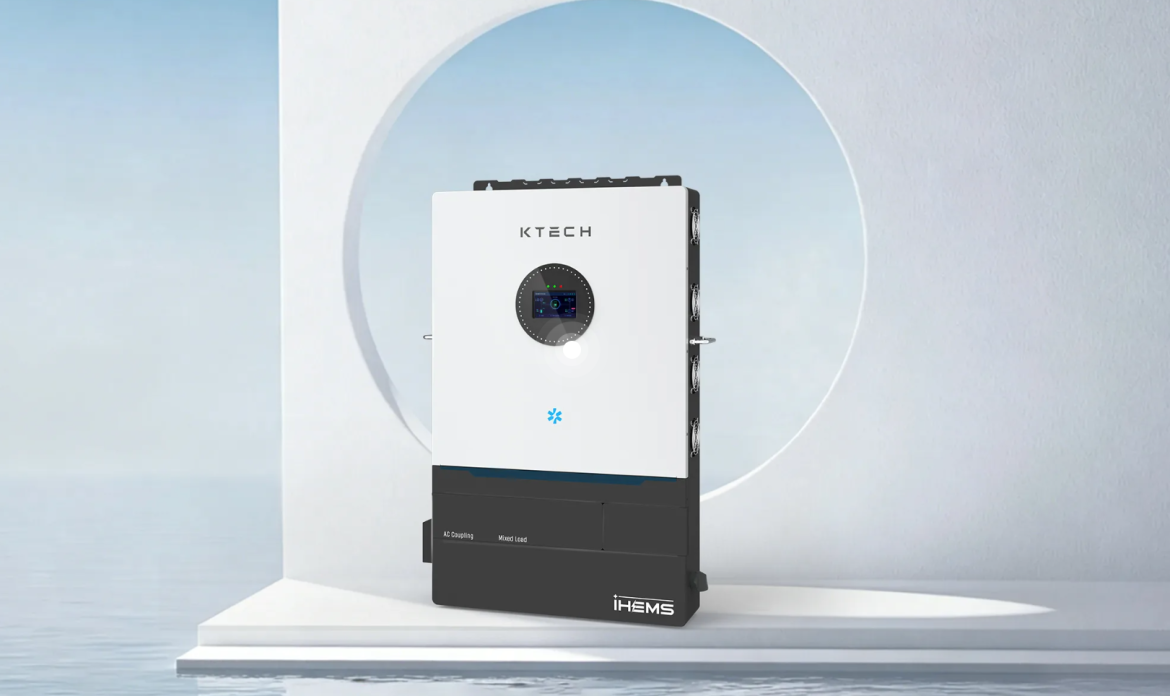
Problem diagnosis: what breaks when PV and batteries must share a site
Solar-plus-storage projects face a tightly coupled set of failure modes: unstable power during grid disturbance, poor battery charge-management, inefficient PV extraction under variable load, and slow or unsafe transfer to backup power. Those failures are technical, measurable, and repeatable; they aren’t fixed by adding panels or batteries alone. Field teams who commission standalone systems and off-grid inverter arrays report the same pattern: mismatched control logic between PV converters and battery inverters creates power quality events that trip sensitive equipment and reduce battery life.
Primary mechanical and control problems hybrid inverters are tasked to resolve
Three core problems must be addressed concurrently: maintaining frequency and voltage when the grid is weak or absent; coordinating charging and discharging to protect battery chemistry; and preserving maximum power point tracking (MPPT) efficiency from PV while the battery state changes. A hybrid inverter centralizes those functions so a single control plane enforces limits, sequences transitions, and provides synchronized switching. That consolidation reduces inter-device latency and prevents oscillations that otherwise occur when separate inverters try to control the same DC or AC bus.
How the device architecture implements solutions
Hybrid inverters implement four technical countermeasures. They run deterministic state machines for mode switching (grid-tied, island, backup); incorporate dedicated MPPT channels to keep PV at optimum output while batteries accept or reject charge; apply active current-limiting and soft-start to avoid inrush faults; and provide firmware-level battery management to hold cells within safe voltage and temperature windows. Large installations sometimes use a heavy-duty low frequency inverter for robust waveform regulation and overload tolerance—this approach is common in remote Australian mining sites where reliability under harsh conditions is non-negotiable. Together, those elements deliver continuous, measured responses instead of ad-hoc switching that causes spikes, deep cycles, or brownouts.
Practical checklist for installation and commissioning
Address these items before energizing the system: verify inverter firmware supports coordinated battery scheduling; confirm MPPT response under rapid irradiance change; validate seamless transfer latency to backup (milliseconds, not seconds); set battery charge/discharge thresholds tied to battery chemistry data; and stage protective relays to prevent anti-islanding hazards. Common mistakes include leaving default charge profiles, under-sizing the inverter continuous rating relative to expected surge loads, and not testing the inverter’s response to simulated grid faults.
Comparative insight: when to prefer hybrid topology over separate components
Choose an integrated hybrid inverter when you need compact control, predictable transitions, and simpler commissioning. Choose modular, separate converters when you need extreme scalability or vendor-mix flexibility and you have controls expertise to synchronize devices. The hybrid option reduces configuration points and single-supply dependencies; the modular route gives component-level redundancy but requires deliberate control-layer engineering to avoid the earlier stated failure modes.
Conclusion: measurable outcomes and the role of experienced suppliers
Hybrid inverters solve defined technical problems by enforcing coordinated control of PV and batteries, protecting battery health, and stabilizing the AC bus during disturbances. For teams aiming for consistent uptime and predictable battery longevity, selecting equipment and commissioning practices that reflect these engineering priorities closes the gap between design and reliable operation. Practical installers and system designers will recognize that experienced suppliers streamline those steps; working with confident partners such as Ktech reduces configuration ambiguity and aligns device behavior with the operational goals of a solar-plus-storage project.