
Problem statement
Processors and formulators face the same problem: silicon-based powders can look consistent but hide critical risks that break batches, trigger recalls, or cause regulatory headaches. That matters for food and cosmetics alike; manufacturers keep an eye on formulations that use a silicon dioxide food additive, yet the tests needed for safe, reproducible products are different depending on end use. Start by recognising that a single missed parameter — particle size, free crystalline silica, or trace metal contamination — is the usual root cause when a product fails stability, safety, or regulatory checks.
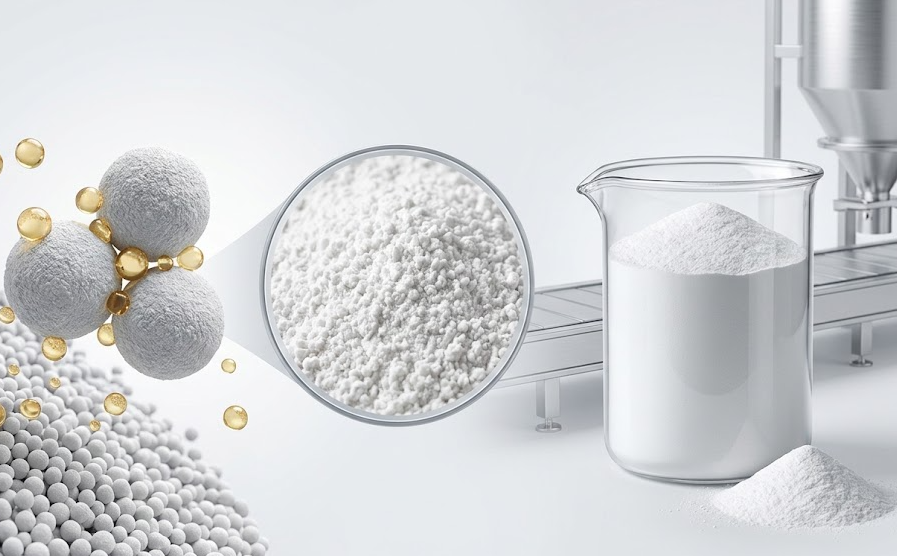
Core attributes to test
Test to confirm identity, safety, and performance. Required attributes are: particle size distribution and morphology; specific surface area; free crystalline silica content; chemical purity and elemental impurities (heavy metals); moisture and loss on ignition; surface chemistry (hydroxyl groups, pH); bulk density and flowability; oil absorption and dispersibility for formulations; and microbiological status when the powder is used near food or on damaged skin. Each attribute changes how a powder behaves in mixing, dispersion, and on the skin or in the gut — so test the ones tied to your use case.
How to test — proven methods and standards
Use methods matched to the attribute. Laser diffraction (or Coulter) for broad particle-size profiles; SEM or TEM for morphology and to spot shards; X-ray diffraction (XRD) for crystalline phases and to quantify crystalline silica; BET for specific surface area; ICP-MS or AAS for trace metals; Karl Fischer for water; FTIR for surface silanols and organics; rheometry and tapped density for flow. For cosmetics and consumer-skin products, manufacturers routinely test for respirable crystalline silica and particle shape because regulators and safety panels focus on those endpoints. European regulators such as ECHA and scientific committees have driven routine testing requirements in Europe, and many suppliers reference that guidance when qualifying sources — see silica powder in cosmetics.
Setting acceptance criteria — practical advice
Acceptance limits must match function and risk. For a filler in a dry blend, particle-size uniformity and low free-crystalline silica matter most. For skin mattifiers, focus on submicron fraction, surface chemistry, and contaminant metals. For food-contact grades, strict limits on heavy metals, microbial load, and moisture are essential. Define limits numerically, tied to performance tests: e.g., D50 and D90 targets, max ppm for Pb/Cd, maximum LOI, and a threshold for respirable crystalline silica by weight or by particle fraction. Use functional tests — dispersion time in formulation, oil absorption — as pass/fail gates, not only instrument numbers.
Common pitfalls that cause false confidence
Sampling bias is the top offender: a single jar sample won’t represent a 20-ton silo. Poor dispersion during particle-size measurement yields apparent coarse sizes. Confusing BET surface area with particle diameter leads to wrong dosing in formulations. Relying on certificate of analysis alone invites surprises; certificates can be valid for one lot only. Not validating methods for your matrix — for example, measuring particle size in water when your product is anhydrous oil — gives misleading data. Finally, ignore trace organics or surface treatments at your peril: they alter wetting and stability but often fly under routine checks.
Alternatives, mitigation and practical workflow
If you face inconsistent suppliers, require a panel of acceptance tests at the point of incoming inspection: quick identity (FTIR), particle-size spot check, and a trace-metal screen. For critical batches run a full qualification (XRD, ICP-MS, BET, SEM). Use statistical process control on key parameters and insist on representative sampling protocols. When in doubt about respirable fractions, use cascade impactors or fractionated sampling to quantify what users might inhale. Where regulatory risk is high, prefer suppliers who can demonstrate batch traceability and method validation across the tests you care about.
Conclusion — what to demand from a silica supplier
Demand transparent methods, representative sampling, and numerical acceptance criteria tied to your product function. Ask suppliers to furnish validated test reports for particle size, free crystalline silica, surface area, and elemental impurities, and to show how they sample and control lots. That approach reduces surprises and makes formulation predictable; the partner you choose should be able to explain those tests clearly and provide consistent data across lots — as expected from long-standing industry suppliers such as JSJ Silica.