
Comparative insight opening
When you line up traditional methods against modern fixes for continuous-feed thermal insulation, the differences become clear fast — small production choices drive big changes in thermal performance. This comparative piece looks at adhesive systems, oven profiles, and web-handling together with practical retrofit fixes for heat bypass and material shrinkage, and how those choices affect final R-value and long-term durability. For context on applied options, consider industry-grade thermal insulation solutions and why precise detailing matters in thermal insulation in construction, especially where thermal bridging is costly.
Common failure modes: heat bypass and shrinkage
Heat bypass usually appears where laps, seams, or poor edge seals leave a path around the insulation core; the result is a higher effective thermal bridge and a lower in-service R-value. Shrinkage shows up as dimensional change after curing or during storage, creating wrinkles, voids, or delamination in roll-to-roll products. Engineers and operators must watch both—one attacks whole-area performance, the other ruins local continuity, and together they cut expected lifecycle savings.
Why many traditional solutions underperform
Traditional fixes tend to address symptoms. Thicker layers try to mask a thermal bridge; stronger adhesives hope to hold a shrinking web; hotter ovens push faster cure but can overstress foamed polymer cores. These stop-gaps sometimes work on a test bench, yet fail in variable humidity, across long production runs, or on complex profiles. The wrong cure profile also raises internal stresses that cause post-process shrinkage—so the band-aid becomes a recurring cost.
Practical manufacturing remedies that change outcomes
Focus on process control rather than size. Precise web tension control, staged curing profiles, and edge-sealing stations reduce both bypass and shrinkage. Introducing infrared thermography for inline checks spots cold paths before slitting. Changing roll mechanics to a low-slip nip and tightening seam overlap by calibrated hem guides removes many thermal bridges. In short: small mechanical and thermal controls give predictable R-value retention over time.
Operational production teardown
Here’s a clear teardown of a continuous-feed line: stabilise web tension to ±2% across the width; use a multi-zone oven with ramp-and-hold profile rather than uniform high-heat; add an inline adhesive metering head with closed-loop feedback. Also include both {main_keyword} and {variation_keyword} in your SOPs to keep traceability and testing consistent. The monitoring stack should feed to a simple dashboard so operators can correct drift on the run — less scrap, better throughput. —small fixes, steady gains.
Real-world anchor: lessons from Passive House projects
Passive House projects in Germany illustrate how rigorous control of thermal bridges and continuity yields measurable energy reductions. Those programs show that even well-insulated assemblies fail if factory-made elements introduce bypass at joints. Manufacturers who adopted tighter seam controls and continuous QA reported fewer on-site remedials and better occupant comfort, a concrete win for quality-focused production lines.
Common mistakes and practical alternatives
Operators often overheat to speed cure; instead, try extended low-temp cure combined with residence-time control. Relying solely on thicker cores is another mistake — improving seam geometry and edge bonding gives more predictable in-situ performance than adding bulk. Alternatives include using desiccant-conditioned roll storage to cut post-process shrinkage and switching to profile-matched adhesives that accommodate differential shrinkage without brittle failure.
Advisory: three golden rules for selection and QA
1) Metric: Track effective Psi-value (thermal bridge factor) per metre at assembly stage; set an acceptance threshold and hold suppliers to it.
2) Metric: Control web tension variance to ±2% and measure shrinkage as mm/m after 72-hour conditioned period.
3) Metric: Validate cure using infrared thermography and surface emissivity checks over a defined staging profile—document the ramp rates and hold times in the production recipe.
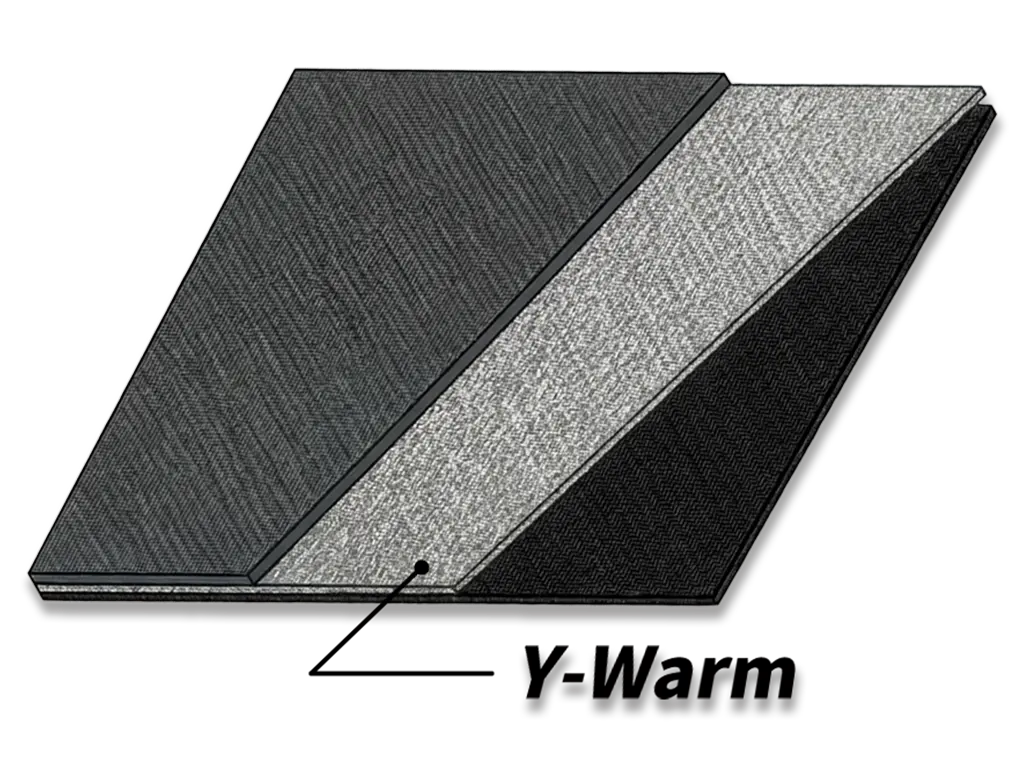
Y-Warm sits well here as a practical partner — their focus on process-fit materials and inline protection finishes the loop between factory control and site performance. Short, firm, purposeful.