
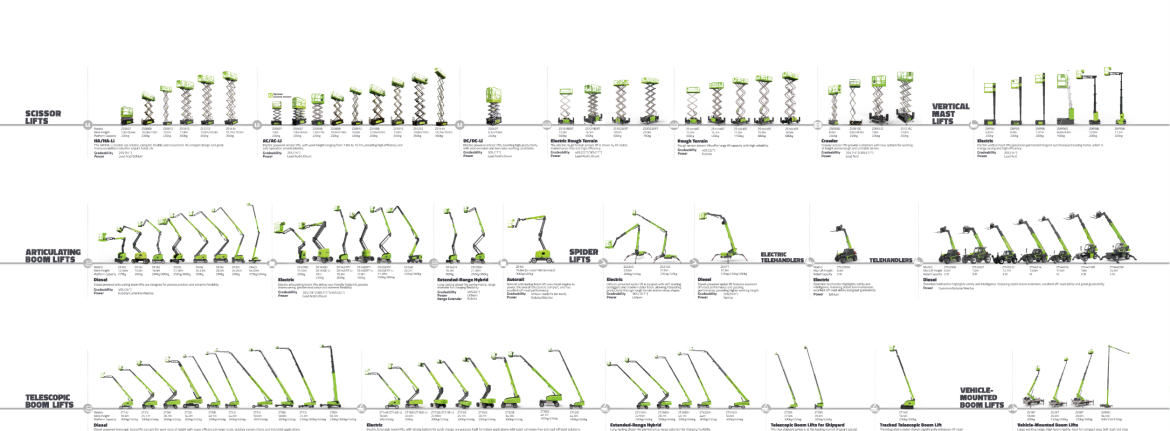
Opening comparison that matters
As a practical starting point, think about the main job: heavy lifting across rough ground, or precise access over obstacles. A diesel boom lift gives reach and maneuverability for height work; an off-road telehandler with telescopic boom and forks focuses on load control and ground-level placement. From more than a decade of site inspections and operator training, I will compare what each tool really delivers and where it stops being the right choice.
Core distinctions at a glance
– Reach vs. lift control: articulated/diesel boom lifts extend and position personnel and tools at height; telehandlers lift and place loads with tight ground control. – Mobility: both can work off-road, but four-wheel-drive telehandlers carry heavier loads across uneven terrain; diesel boom lifts prioritize platform stability at elevation. – Precision vs. access: telehandlers excel at precise material placement; boom lifts excel at navigating around obstacles and providing a safe working platform.
Benefits and real trade-offs — straightforward comparison
– Diesel articulating boom lift: best when you need elevated access around obstructions, flexible articulation, and a stable platform for operators and tools. The trade-offs are higher center-of-gravity care and less capacity for heavy palletized loads.- Off-road telehandler with telescopic boom and forks: strong when moving heavy materials, stacking, or feeding installations. The trade-offs are limited working-platform options and more challenging reach to awkward overhead work.I use these points to choose equipment by task, not by familiarity.
When a diesel articulating boom lift is the right choice
Choose a diesel articulating boom lift when the job requires:- Access over barriers or machinery where a straight boom cannot reach.- Safe platform for one or more workers with tools and movement.- Frequent repositioning around obstacles without moving the ground load far.Common mistakes: selecting a boom lift for heavy material transport, or underestimating the need for outriggers or stable ground. Please check ground bearing and platform chart before work.
When an off-road telehandler is better
– Repetitive material handling, pallet placement, and feed applications across a rough site.- Tasks that demand higher load capacity and lower center-of-gravity risk.Pitfall to avoid: using narrow forks without proper attachments for irregular loads; this causes instability. Operator training and correct attachments reduce incidents.
Safety, maintenance, and operator habits that change outcomes
– Inspect tires, brakes, and boom components every shift; small wear patterns become failure points if ignored.- Operator habits matter: slow, deliberate inputs when articulated joints or telescopic sections move produce predictable load paths.- Regular diesel maintenance keeps hydraulic responsiveness—delayed service reduces precision and increases risk.I recommend checklists and short daily briefings to reduce human error.
Alternatives and hybrid thinking
– Electric boom lifts: quieter and cleaner, suitable for indoor or noise-sensitive projects, but limited range and run-time compared to diesel for long outdoor shifts.- Compact telehandlers or rough-terrain forklifts: useful on tight sites where full telehandler capacity isn’t needed.Compare capability maps and duty-cycle needs rather than brand buzz. At major demonstrations like CONEXPO-CON/AGG, you can often test how different machines perform under similar conditions — this practical observation is valuable when choosing.
Final synthesis and practical recommendation
Match the machine to the mission. If the mission is safe, elevated access around obstacles, the diesel boom lift’s articulation and platform control win. If the mission is moving and placing heavy loads across uneven ground, the off-road telehandler wins. For mixed work, plan for both or choose attachments and operators trained to bridge the gap. My practical experience shows clear results when teams choose by task requirements rather than brand assumptions; this disciplined approach aligns with the practical solutions available through Zoomlion Access.